
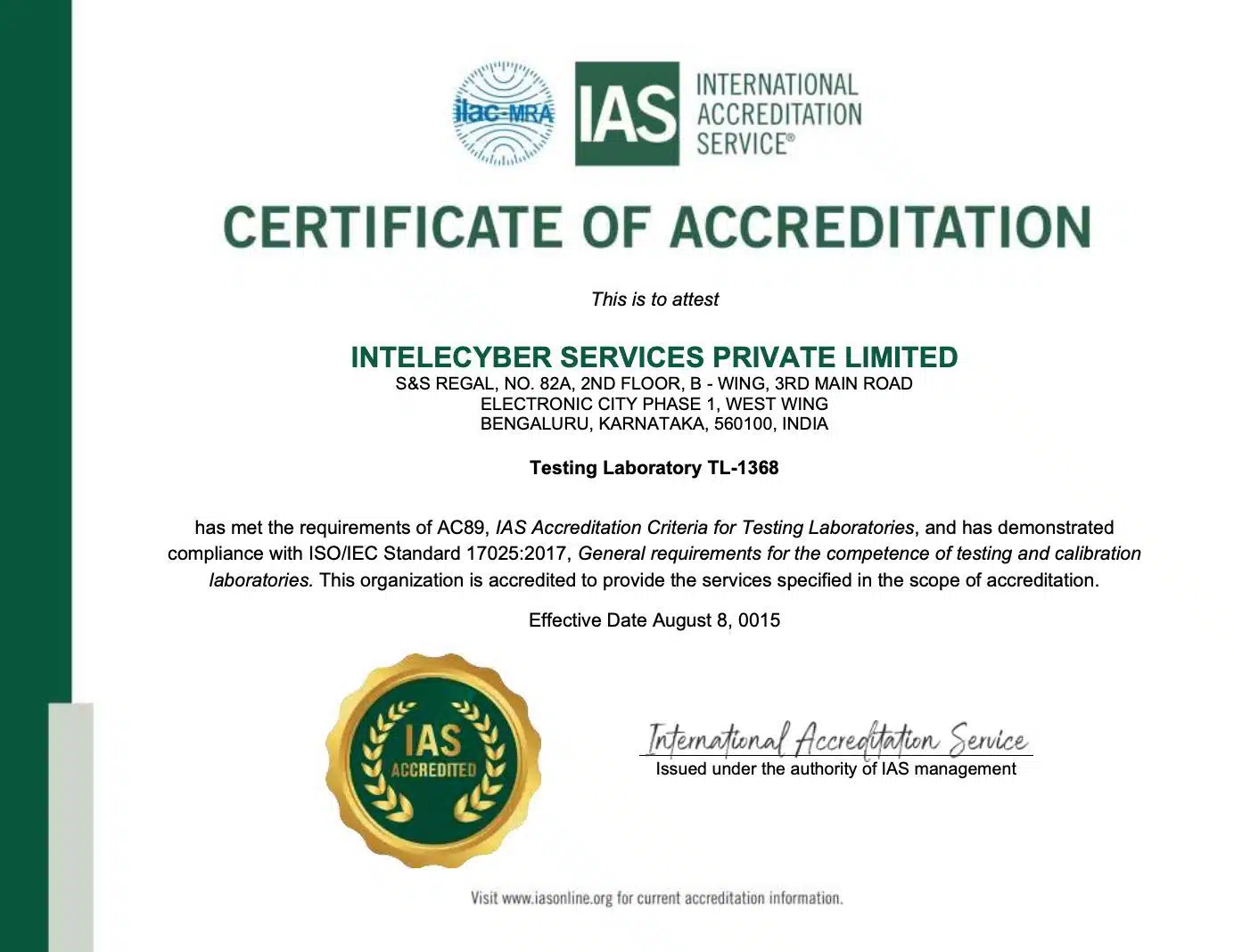
Bengaluru, India, August 8, 2025: InTeleCyber, a niche cybersecurity testing and compliance services provider, is proud to announce that it has successfully earned the ISO/IEC 17025 accreditation from the International Accreditation Service (IAS), a globally respected U.S.-based accreditation body. This achievement marks a significant milestone in InTeleCyber’s journey, validating its technical competence and reliability as a testing laboratory and underscoring its commitment to secure, accurate, and standards-aligned cybersecurity services.
An ISO/IEC 17025-accredited test report demonstrating conformity with EN IEC 81001-5-1 can provide valuable objective evidence of cybersecurity compliance for connected medical devices, including hardware-software medical devices and Software as a Medical Device (SaMD).
The report can support regulatory submissions and conformity assessments involving the US FDA, EU Notified Bodies for CE marking, and India’s CDSCO, subject to the specific cybersecurity requirements and acceptance criteria of each authority.
InTeleCyber is an ISO/IEC 17025-accredited first laboratory in India with EN IEC 81001-5-1 included in its accredited scope for medical-device cybersecurity testing.
Notably, InTeleCyber is among the select few laboratories in India accredited under EN 18031-1/-2/-3, ANSI/UL 2900-1, ANSI/UL 2900-2-1, and ER-01, providing unparalleled capability for testing connected products against the latest regulatory and industry benchmarks.
This accreditation comes at a crucial time, as the EU RED (Radio Equipment Directive) Cybersecurity regulation (Delegated Act) for wireless IoT devices includes automotive infotainment systems and Electronic Sub Assemblies (ESA) became mandatory on August 1, 2025. With its scope covering this requirement, InTeleCyber is strategically positioned to support manufacturers and OEMs in achieving compliance for global market access.
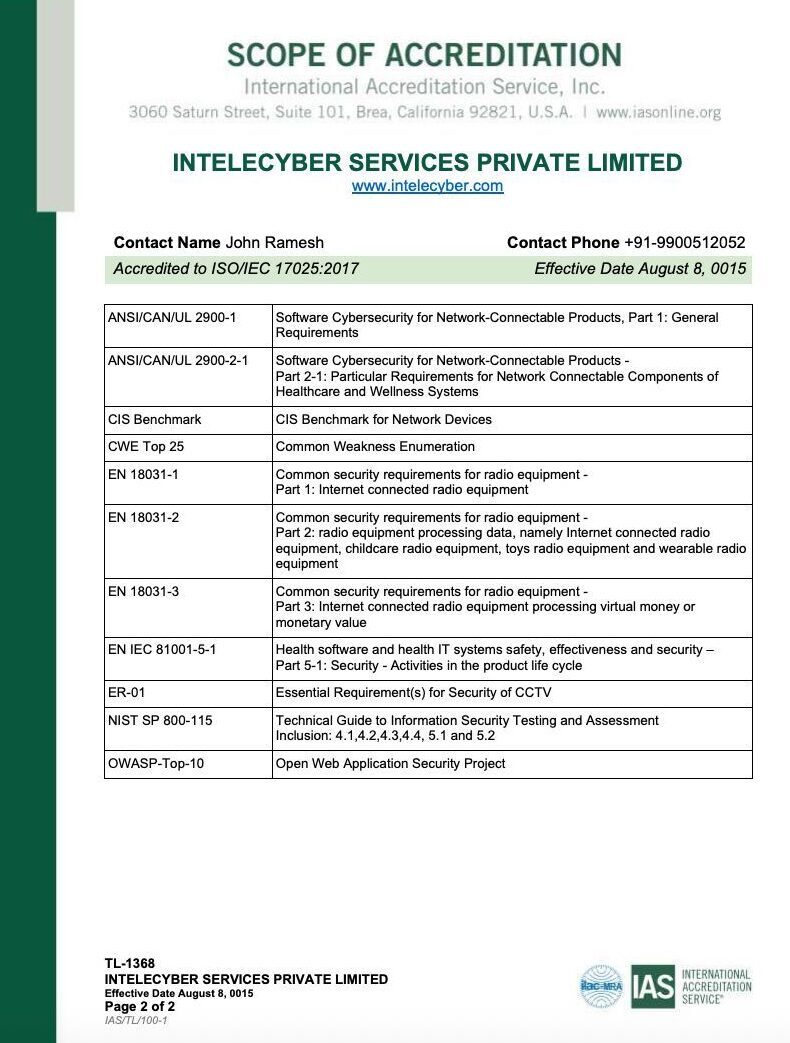
The accreditation scope covers
- EN 18031-1/-2/-3: Common security requirements for wireless IoT devices, including internet-connected equipment, toys, childcare devices, wearable tech, automotive infotainment systems, Automotive Electronic Sub Assemblies (ESA) and radio equipment handling monetary value.
- ANSI/UL 2900-1 & UL 2900-2-1: Cybersecurity for connected IoT and medical devices, recognized across U.S. and global markets.
- EN 81001-5-1: Cybersecurity in health software across the product lifecycle, critical for CE marking in the EU and for US FDA approvals.
- ER 01: BIS CRS cybersecurity compliance for CCTV cameras, ensuring safe and secure surveillance technology.
- Industry-recognized benchmarks: CIS Benchmark for network devices, CWE Top 25 for common weakness enumeration, OWASP Top 10 for web application security, and NIST SP 800-115 for technical security testing and assessment.
These accreditations are not only benchmarks of technical excellence but are vital enablers for product entry into regulated markets, enhancing trust, interoperability, and user safety. For manufacturers, OEMs, and developers, partnering with an ISO/IEC 17025-accredited lab like InTeleCyber means faster market readiness, stronger compliance with India, U.S., and EU regulations, and greater trust in product security.
Commenting on the announcement, John Ramesh, Co-Founder & CEO, InTeleCyber, said, “Achieving ISO/IEC 17025 accreditation from IAS and being among the few labs in India to hold ANSI/UL 2900-2-1 accreditation demonstrates our relentless focus on quality, credibility, and innovation in cybersecurity testing. This milestone strengthens our position as a trusted partner for manufacturers navigating increasingly complex compliance requirements. As regulations like the EU RED Delegated act for cyber security of wireless IoT devices come into effect, our accredited capabilities enable clients to meet stringent global standards with confidence, ensuring safer, more resilient connected products. It’s a testament to the technical excellence of our team and our unwavering commitment to secure innovation.”
This certification reaffirms InTeleCyber’s role as a trusted partner in enabling safer connected ecosystems, supporting product manufacturers across domains such as consumer IoT, medical technology, Automotive, industrial automation, and critical infrastructure.
About IAS (International Accreditation Service)
IAS is a nonprofit, public-benefit corporation that has been providing accreditation services since 1975. IAS accredits a wide range of companies and organizations including governmental entities, commercial businesses, and professional associations. IAS accreditation programs are based on recognized national and international standards that ensure domestic and/or global acceptance of their accreditations. IAS receives funding revenue through the provision of accreditation services and the renewal of these services, as well as training offerings.
These revenues are further used to participate and engage in developing industry-based accreditation programs, domestic and international schemes, including participation in standards development. IAS also maintains signatory status in a number of global multilateral recognition arrangements under Asia Pacific Accreditation Cooperation (APAC), International Accreditation Forum (IAF), and International Laboratory Accreditation Cooperation (ILAC). IAS is a member of the ICC Family of Solutions.
About InTeleCyber
Starting as a specialized cyber security testing services company, InTeleCyber has evolved into delivering holistic cybersecurity solutions with extensive know-how and industry expertise. We recognize that as the world becomes digital-first and embraces automation, cybersecurity will become a top priority for all organizations. We are one of the few cybersecurity service providers that deliver end-to-end support to help product manufacturers, system integrators, and operators optimize their security infrastructure. We go beyond general compliance checks to offer device security testing, conduct assessments, enhance GRC management, and strengthen the cybersecurity workforce within organizations.